
RAND/UCLA Appropriateness Method support in Surveylet
Surveylet can support studies using the RAND/UCLA Appropriateness Method, a structured expert-panel approach commonly used in healthcare to evaluate whether clinical procedures, treatments, criteria, or recommendations are appropriate for specific patient scenarios.
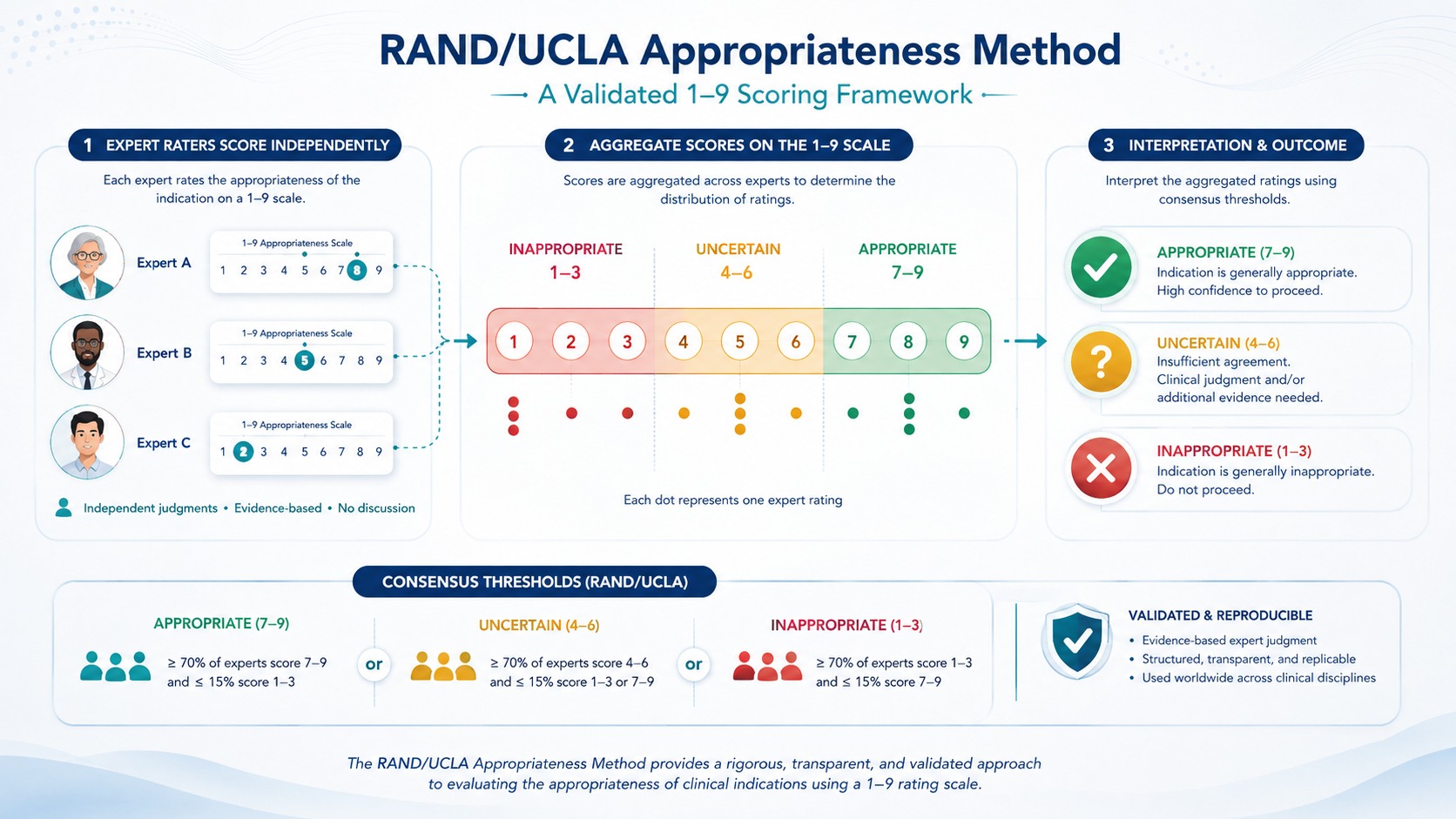
What is the RAND/UCLA Appropriateness Method?
The RAND/UCLA Appropriateness Method is a formal consensus method developed to help determine when the expected benefits of a medical or surgical procedure exceed the expected risks for specific clinical indications.
It is closely related to modified Delphi methods, but it has a specific focus on appropriateness ratings, evidence review, expert-panel judgment, and classification of clinical scenarios as appropriate, uncertain, or inappropriate.
Typical appropriateness rating structure
RAND/UCLA-style studies commonly use a 1–9 rating scale. In the classic framework, ratings are summarized using the panel median and disagreement rules.
How Surveylet can support RAND/UCLA studies
Surveylet can be configured to support appropriateness-method workflows, including expert-panel rating, clinical indication organization, structured feedback, repeated rounds, comments, and exports for classification and analysis.
Clinical indication rating
Organize procedures, treatments, criteria, or recommendations into clinical scenarios or indication statements for expert rating.
9-point appropriateness scales
Use structured 1–9 rating scales aligned with appropriateness-method workflows.
Parallel rating dimensions
When the protocol requires it, collect validity, feasibility, or other judgments separately from appropriateness and apply distinct analysis rules.
Expert-panel workflows
Manage invite-only expert panels, response tracking, reminders, and participant access.
Round-by-round feedback
Provide structured feedback between rounds so panelists can reconsider ratings after reviewing group summaries.
Comments and rationale
Collect panelist comments to understand why items are rated as appropriate, uncertain, or inappropriate.
Analysis-ready exports
Export ratings and comments for calculation of medians, disagreement, dimension-specific classifications, and reporting outputs.
Typical RAND/UCLA-style workflow
When the RAND/UCLA Appropriateness Method is useful
The RAND/UCLA Appropriateness Method is especially useful when healthcare teams need to evaluate whether a procedure, treatment, test, guideline element, care pathway, or decision rule is appropriate under specific conditions.
Good fit for
- Clinical appropriateness criteria
- Procedure or treatment indications
- Diagnostic or imaging appropriateness
- Quality indicators
- Care pathways and decision rules
- Guideline-support studies
Why teams use it
- Combines evidence with expert judgment
- Supports structured clinical scenario rating
- Separates appropriate, uncertain, and inappropriate indications
- Documents disagreement and uncertainty
- Produces transparent outputs for research or policy use
Surveylet platform plus methodology support
Some teams only need Surveylet configured for an appropriateness-method study. Others need broader help with scenario structure, panel workflow, rating scales, feedback design, analysis planning, and reporting.
Calibrum can support RAND/UCLA-style studies as part of its broader Delphi and consensus-study services.
Planning an appropriateness-method study?
Surveylet can support RAND/UCLA Appropriateness Method workflows, modified Delphi studies, real-time Delphi, and medical consensus research. Calibrum can also help your team design, administer, analyze, and report the process.