
Delphi support for core outcome set development
Calibrum supports the Delphi stage of core outcome set development with Surveylet software and optional study services. Bring patient, caregiver, clinician, and researcher perspectives into outcome prioritization, with help for study planning, controlled feedback, consensus meeting preparation, and agreed reporting.
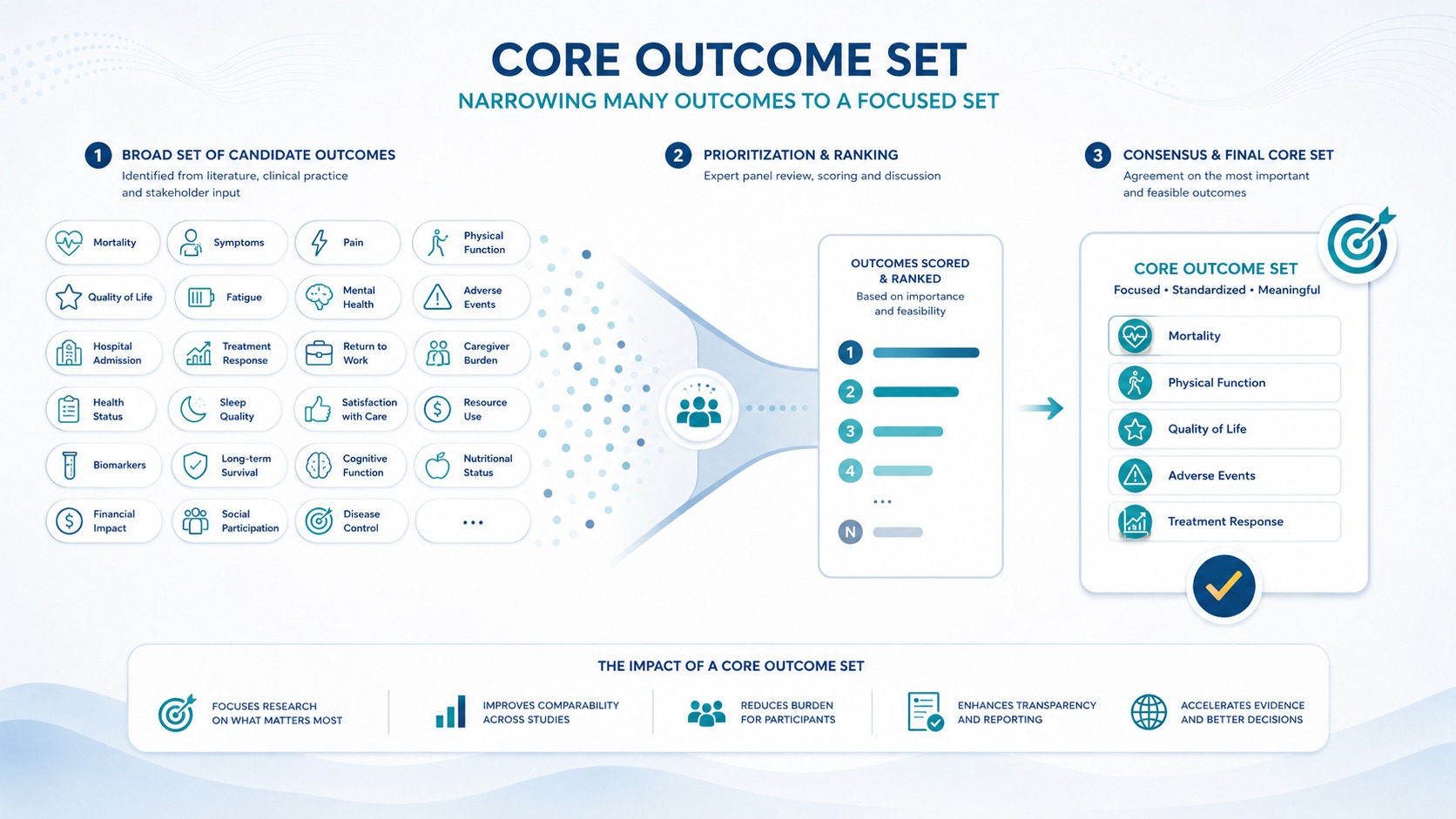
Designed for outcome prioritization and stakeholder consensus
Stakeholder Group Management
Organize participants by stakeholder group, such as clinicians, researchers, patients, caregivers, policy leaders, or professional-society representatives.
Outcome Rating Scales
Use structured rating scales, such as 1–9 importance scales, agreement scales, feasibility scales, or custom rating frameworks.
Round-by-Round Feedback
Provide participants with group-level feedback, distribution summaries, and anonymized comments before they reconsider ratings.
Consensus Tracking
Monitor which outcomes meet inclusion, exclusion, or no-consensus thresholds based on predefined criteria.
Real-Time Delphi Options
Use real-time Delphi methods when the study design calls for faster iteration and participant access to updated group feedback.
Reporting-Ready Outputs
Export data and summaries for analysis, steering-committee review, consensus meetings, supplementary files, and manuscripts.
From long list to final core outcome set
Core outcome set support from planning to reporting
Use Surveylet with your own methodology team or ask Calibrum to help deliver the Delphi workflow. Agree on the support you need at each stage, including any final meeting and reporting deliverables.
Plan the Delphi study
Define stakeholder groups, outcome wording, rating scales, feedback, and consensus rules. Turn-key study services can support methodology planning and questionnaire development.
Run the survey and meeting
Complete Survey Care supports Surveylet setup and operations. A facilitated consensus meeting is separately scoped for outcome review, discussion, and further ratings.
Prepare the study outputs
Agree on the outcome-status summaries, stakeholder comparisons, tables, and methods documentation your team needs. Analysis and final reporting can be added to support your steering committee or manuscript.
Questions about core outcome set studies
Can patients and clinicians take part in the same study?
Yes. Surveylet can organize participants into stakeholder groups so your team can examine their ratings separately and together. Decide in advance which groups to include and whether consensus must be reached within each group.
Can Calibrum support the final consensus meeting?
A separately scoped Live Consensus Session can support independent outcome ratings, anonymized feedback, discussion, and reconsideration. The steering group defines how the meeting will resolve remaining items and confirm the final set.
What should our team prepare before setup?
Provide the proposed study scope, candidate outcomes and definitions, stakeholder groups, draft protocol, and planned outputs. Confirm the rating scale, feedback approach, and consensus rules before launch. Our study design checklist helps organize these decisions.
Developing a core outcome set?
Calibrum can help you structure the Delphi process, configure Surveylet, support stakeholder participation, and prepare analysis-ready outputs for your steering committee, consensus meeting, or manuscript.